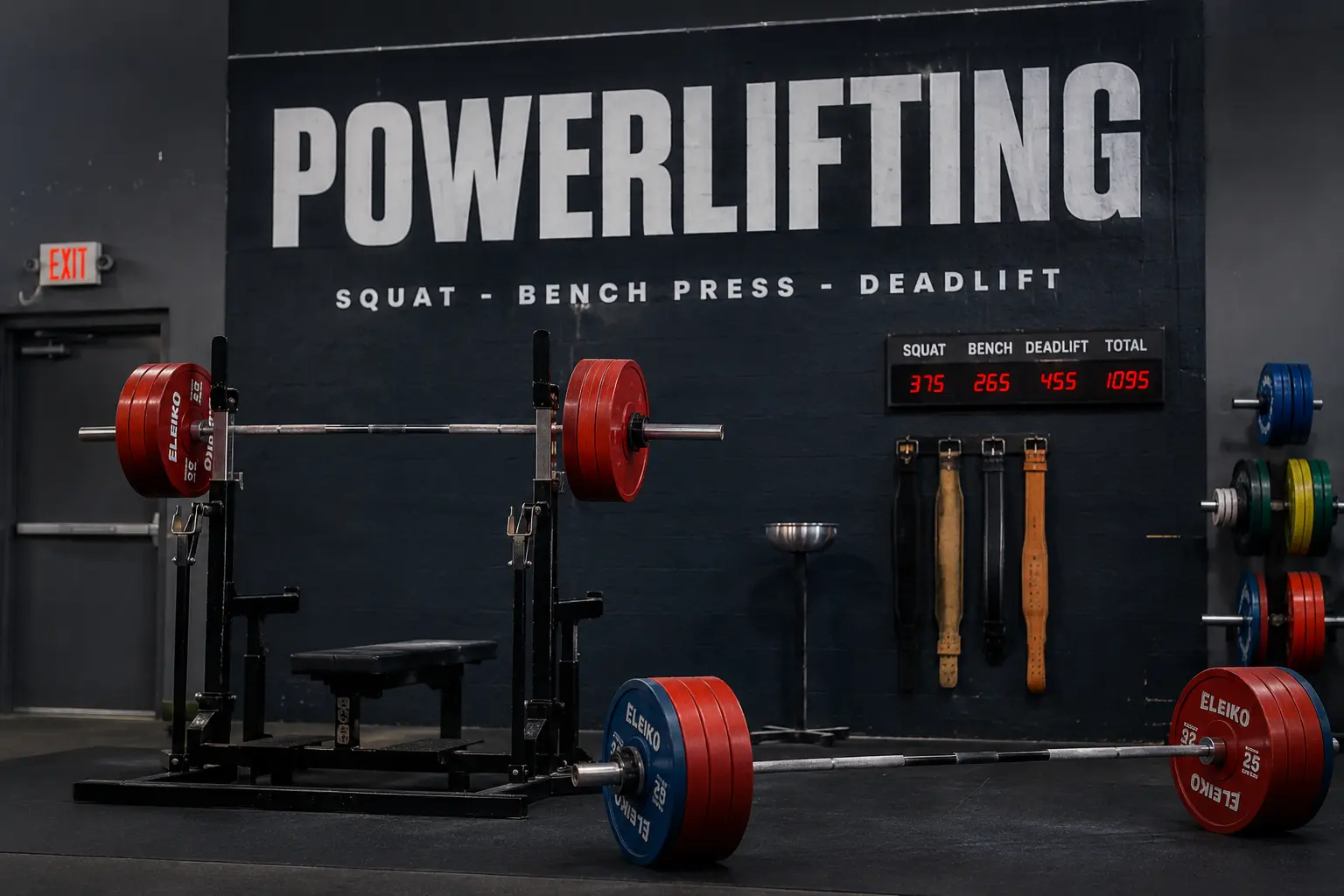
Powerlifting is a strength sport built around three lifts: the squat, the bench press, and the deadlift. The goal is simple to state and hard to do. Lift the heaviest weight you can for a single rep on each movement, and let the combined total decide the winner.
What makes it different from just “lifting heavy” at the gym is that powerlifting is judged. You either complete the lift to a fixed technical standard, or you don’t. There’s no partial credit for a squat that doesn’t hit depth or a deadlift that gets stuck halfway up. That objectivity is part of why people get hooked on it. Your numbers don’t lie, and neither do the judges.
This guide walks through the three core lifts, how meets are scored, where the sport came from, how it compares to other strength disciplines, the gear you’ll actually need, and the mistakes that trip up almost every beginner. By the end, you should have a clear picture of what powerlifting actually involves and how to start training for it.
The Three Lifts That Define Powerlifting
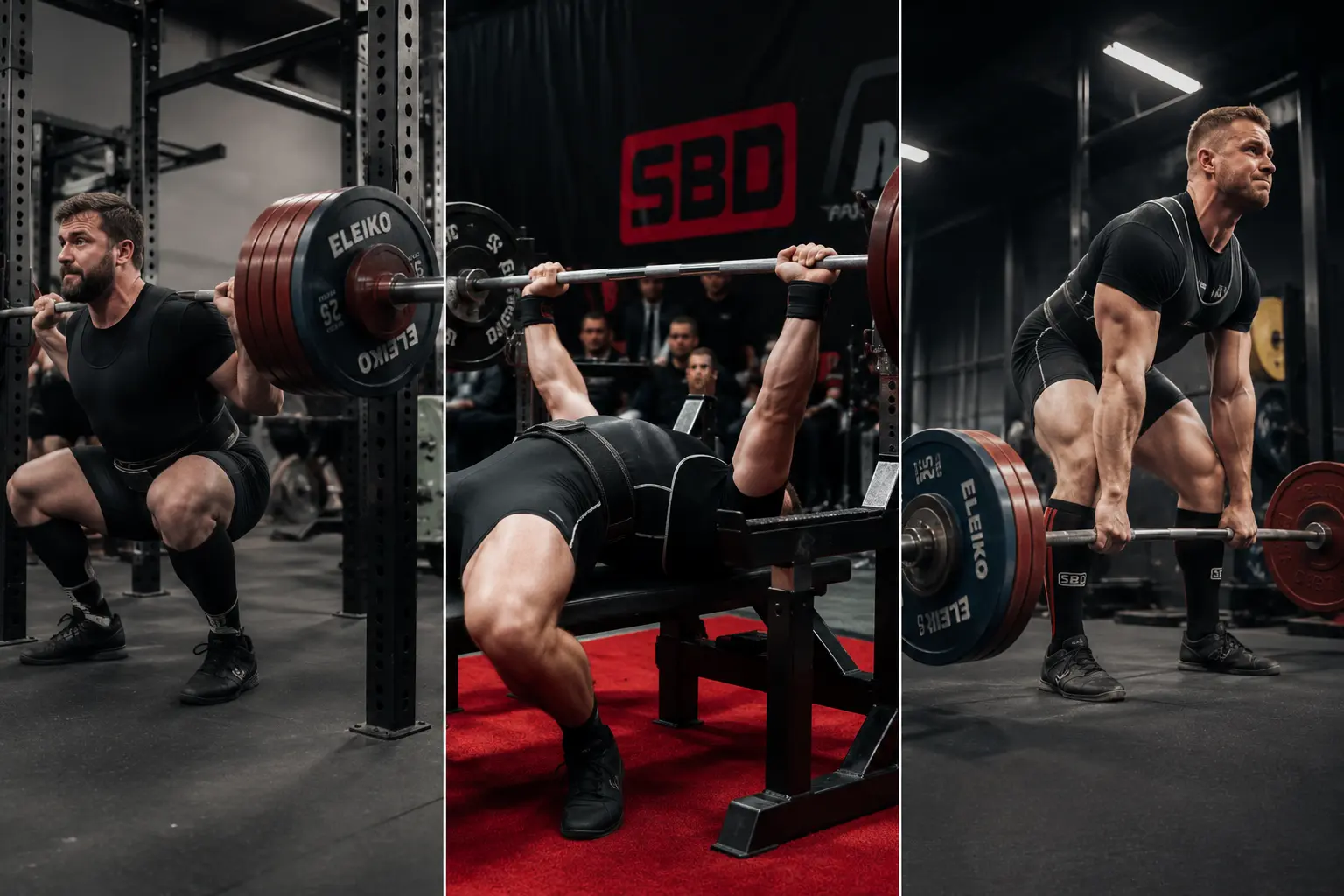
Every powerlifting meet, from a small local gym competition to the IPF World Championships, comes down to the same three movements performed in the same order.
The Squat
The squat goes first. You set the bar across your upper back, walk it out of the rack, and wait for the head judge to give the “squat” command. From there, you descend until the crease of your hip drops below the top of your knee, then stand back up under control. You can’t rack the bar the moment you lock out your knees. You have to wait for the “rack” command, and your feet need to stay planted until then.
The squat hits your quads, glutes, hip adductors, and lower back hard. It’s often the heaviest of the three lifts for most people, and it tends to set the tone for how the rest of the meet goes mentally.
The Bench Press
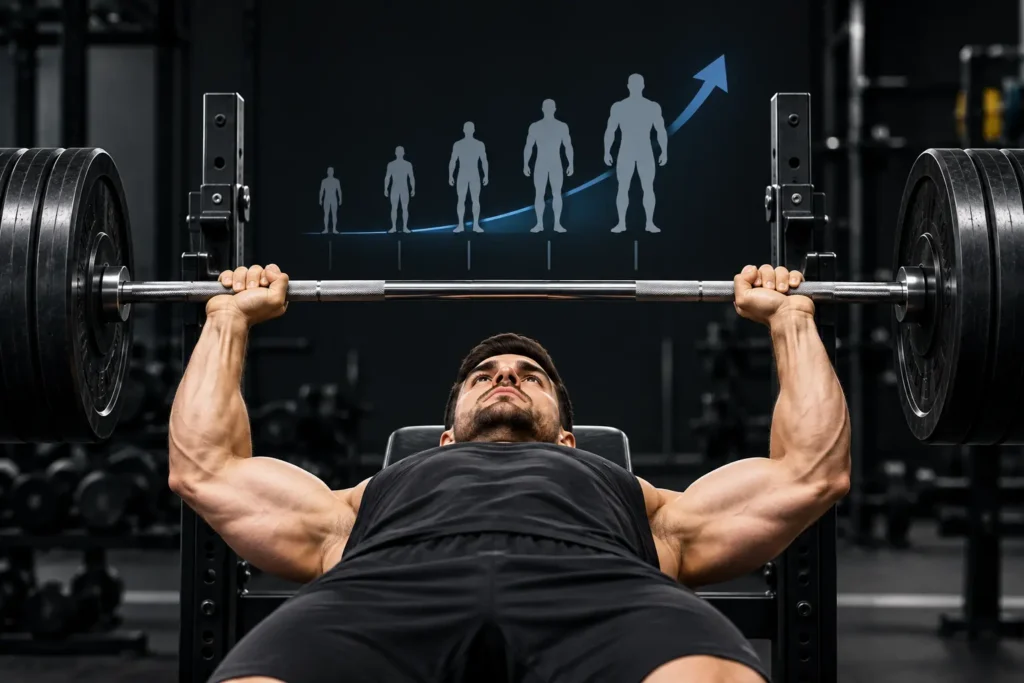
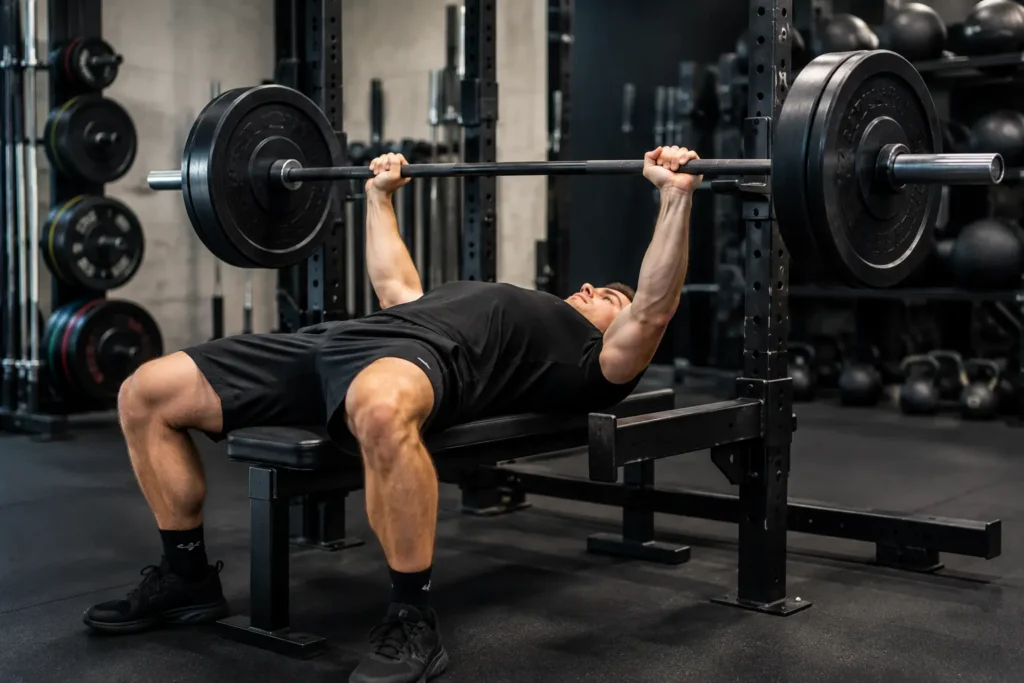
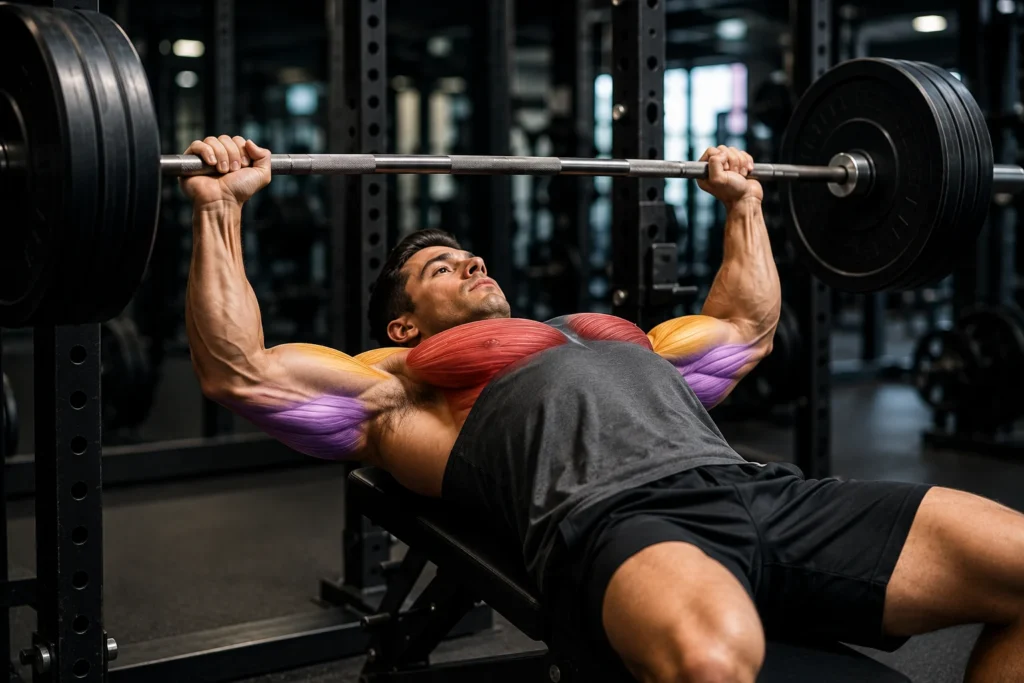
The bench press comes second, and it’s deceptively technical. The barbell has to come down under control, pause motionless on your chest, then press back up to full lockout without any double-bouncing or uneven pressing motion. A 2023 rule update from the IPF added another layer: your elbows need to stay in line with or below the top of your shoulder at the bottom of the press, similar in spirit to the squat depth rule (Source: International Powerlifting Federation).
Grip width matters here more than people expect. Lifters generally settle into a close, regular, or wide grip depending on arm length and torso size, and the right choice can change how much weight you’re able to move. A lot of athletes who are strong in the gym still struggle with bench press technique in competition simply because the commands and the pause catch them off guard the first time.
The Deadlift
The deadlift closes out the meet. You pull the bar from the floor to a full standing lockout in one continuous motion. No hitching the bar up your thighs in small jerky movements, no leaning back excessively to finish the pull. Once you’re locked out, you wait for the “down” command before lowering the bar.
Most lifters choose between a conventional stance, feet roughly hip-width apart, or a sumo stance, feet wide with toes pointed outward. The choice usually comes down to body proportions and which version lets you produce the most force with the shortest possible bar path. Some federations don’t even count sumo as a “true” deadlift in casual conversation, even though it’s allowed in nearly all competitions.
Across all three lifts, the underlying theme is the same. Powerlifting isn’t about isolating one muscle. It’s about coordinating your whole body to move the most weight possible while staying inside a strict technical standard. If you’re working on building that foundation, a structured beginner program built around these three movements is worth more than any amount of random gym wandering. You can find one in our Big 3 training programs.
How Powerlifting Is Scored
A full powerlifting meet, sometimes called “full power,” gives each lifter three attempts at the squat, then three at the bench press, then three at the deadlift. That’s nine attempts total over the course of the day.
Before the meet starts, lifters declare their opening weight for each lift. After a successful attempt, you declare your next weight on the spot. Miss a lift, and you can either repeat the same weight or try something different on your next attempt.
Each lift is judged by three referees. You need at least two white lights out of three to count as a “good lift.” Get two or three red lights, and the attempt doesn’t count toward your total.
Your powerlifting total is the sum of your single best successful squat, bench press, and deadlift. That number, not any individual lift, is what ranks you against everyone else in your weight class. This is worth repeating because it surprises a lot of newcomers: being exceptional at one lift doesn’t make you a strong powerlifter overall. A lifter with a massive squat and a weak bench will often lose to someone with three balanced lifts. The total rewards well-rounded strength, not specialization.
A Short History of Powerlifting
The sport’s roots trace back to the 1950s and 60s in the United States and Britain, where strength athletes grew frustrated with weightlifting competitions that rewarded technique and timing as much as raw power. They started competing in “odd lifts,” informal contests involving a rotating mix of strength feats, before gradually narrowing the format down to the squat, bench press, and deadlift.
The first national powerlifting competition in the U.S. was held in September 1964, organized under the York Barbell Company. From there, the sport spread and standardized fairly quickly, eventually leading to the formation of the International Powerlifting Federation, which still governs much of the global competitive scene today.
Equipment changes shaped the sport almost as much as rule changes did. In 1983, John Inzer invented the bench shirt, a supportive garment that stores elastic energy and assists the press. Squat and deadlift suits followed the same principle. Some federations embraced increasingly supportive multi-ply gear, while others, including the IPF, kept stricter limits on what counted as legal equipment. That split is why you’ll hear lifters talk about “raw” or “classic” powerlifting versus “equipped” powerlifting. Another notable invention, the Monolift, arrived in 1992 and changed how squats were set up by removing the walkout portion of the lift entirely, though plenty of federations still don’t allow it.
Powerlifting vs. Other Strength Sports
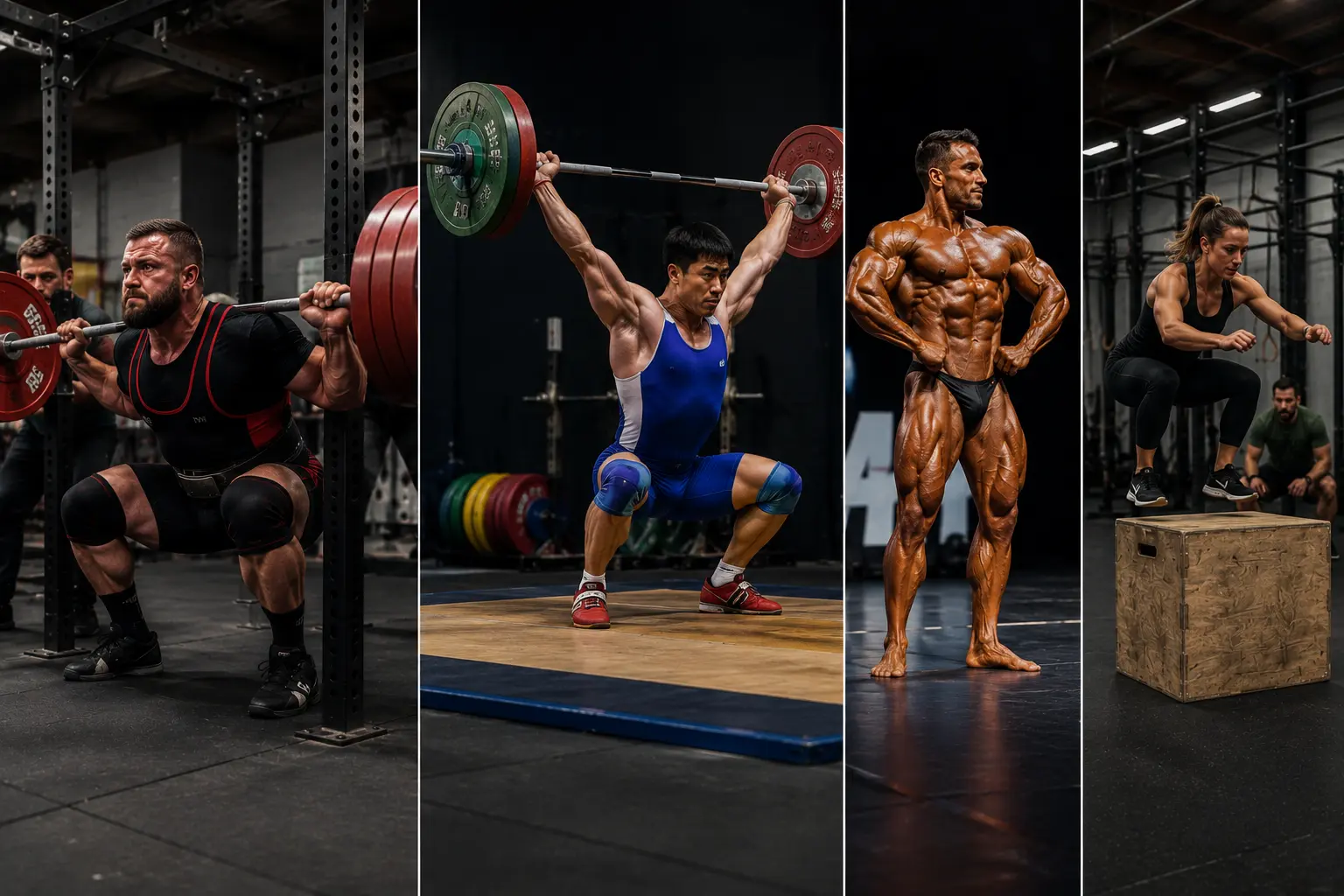
People often lump powerlifting together with other barbell sports, but the differences matter once you start training seriously.
Powerlifting vs. Olympic Weightlifting
Olympic weightlifting revolves around the snatch and the clean and jerk, both of which demand speed, explosiveness, and a high degree of technical mobility to get the bar overhead. Powerlifting, by contrast, is about moving maximal weight through a much simpler range of motion. A powerlifter doesn’t need the same overhead mobility or explosive timing that an Olympic lifter does, but they need far more raw strength endurance across heavy singles.
Powerlifting vs. Bodybuilding
Bodybuilding is judged on appearance: muscle size, symmetry, and conditioning on stage. Powerlifting is judged purely on performance. You can have a relatively unremarkable physique and still put up an enormous total if your strength-to-bodyweight ratio is dialed in. Training also diverges. Bodybuilders typically chase higher rep ranges and isolation work to maximize muscle growth, while powerlifters spend most of their training focused on the specific strength and technique needed for the three competition lifts.
Powerlifting vs. CrossFit and Functional Fitness
CrossFit and similar functional fitness programs borrow elements from powerlifting, Olympic lifting, gymnastics, and conditioning, then blend them into varied daily workouts. Powerlifting, on the other hand, is intentionally narrow. There’s no daily WOD variety. You’re training the same three lifts, week after week, for months at a time, which is exactly why progress tends to be so measurable.
Equipment Used in Powerlifting
You don’t need much to start training, but competing adds a few more requirements.
For training, the basics cover you: a barbell, weight plates, collars to secure the plates, and a sturdy lifting belt. Many lifters also use knee sleeves or wraps for joint support, wrist wraps for pressing stability, and chalk to improve grip and prevent slipping during the squat and bench.
In competition, you’ll see a clear split between equipped and raw (sometimes called “classic”) divisions. Equipped lifters wear supportive squat suits, bench shirts, and deadlift suits made from materials that store elastic energy and genuinely assist the lift. Raw or classic lifters compete with minimal support, typically just a belt, and sometimes knee sleeves or wraps depending on the federation’s rules. Interestingly, a weight belt is one of the only pieces of gear allowed across nearly every federation in raw competition.
One thing you won’t see in competition, no matter the federation, is lifting straps on the deadlift. They’re common in training to take grip strength out of the equation, but every major federation bans them on the platform because grip strength is considered part of the test.
If you’re putting together a home or gym setup and want guidance on what’s actually worth buying versus what’s optional, our powerlifting equipment guide breaks down the essentials without the upsell.
Powerlifting Federations and Weight Classes
There’s no single governing body that runs all of powerlifting worldwide. Instead, you’ll find a patchwork of federations, including the IPF, USA Powerlifting (USAPL), USPA, SPF, and many regional or national organizations, each with its own rulebook.
These differences aren’t trivial. Some federations require a “start” command before the bench press; others never have. Some allow the Monolift; others forbid it entirely. Drug testing policies vary too, with some federations running fully tested divisions and others operating untested or “open” divisions.
Within any federation, competitors are grouped into weight classes, along with age categories and separate divisions for men and women. This keeps competition fair, since a 145-pound lifter and a 250-pound lifter are working with very different leverages and muscle mass.
If you’re thinking about competing for the first time, the practical move is to look at which federations actually run meets near you, then decide whether you want a tested or untested division based on your personal goals. That decision matters more for your long-term experience in the sport than people often realize going in.
Benefits of Powerlifting Beyond the Platform
Competing isn’t the only reason people get into this sport. The training itself delivers a lot on its own.
The squat, bench, and deadlift are compound, multi-joint movements, which means each rep recruits a large amount of muscle mass at once. That makes powerlifting training efficient for building total-body strength, far more so than isolation-focused routines.
There’s also a well-documented connection between resistance training and bone health. Loading your skeleton with progressively heavier weight stimulates bone density adaptations, which becomes increasingly valuable as you age and the risk of bone loss rises. Powerlifting, by its nature, is one of the more direct ways to apply that kind of progressive loading safely.
Functional carryover is real too. Picking heavy things up off the ground, carrying loaded groceries, moving furniture, these everyday tasks get noticeably easier once you’ve spent time building real strength under a barbell.
And then there’s the structure itself. Powerlifting gives you a clear, measurable way to track progress over months and years. Few other fitness pursuits offer that same kind of objective feedback loop, where you can point to a specific number and say, “that’s heavier than I could lift six months ago.”
Common Mistakes Beginners Make in Powerlifting
Almost every lifter makes some version of these mistakes early on. Recognizing them ahead of time can save you a lot of frustration.
- Chasing heavy numbers before locking in proper technique, which usually leads to stalled progress or injury down the line
- Training with gym-style form and assuming it’ll translate directly to competition standards, when commands, pauses, and depth requirements often catch first-timers off guard
- Increasing weight too quickly without managing recovery, energy intake, or sleep
- Underestimating the bench press because it looks like the “simplest” of the three lifts, when it’s often the most technically demanding
- Skipping coaching entirely and trying to self-diagnose form issues that a second set of eyes would catch immediately
- Treating powerlifting as a short sprint instead of a long-term pursuit, then burning out within a year when progress naturally slows
The lifters who stick around longest tend to be the ones who accept that strength gains compound slowly. There’s no shortcut around consistent, well-programmed training.
How to Get Started with Powerlifting
If you’re brand new, start with the movement patterns themselves under light weight, ideally with a coach or experienced lifter who can catch form breakdowns before they become habits. Early progress tends to come fast. A 10-pound increase on squats and deadlifts, and 5 pounds on bench, is common from session to session in the first few months, though that rate of progress naturally slows as you advance.
Learn the competition commands and judging standards before you ever step on a platform. Practicing “competition style” reps, full pauses on the bench, proper depth on squats, no hitching on deadlifts, will make your first meet feel far less chaotic.
Once your technique feels solid, look into local federations and meets in your area. Decide whether a tested or untested division fits your goals, then register for a meet once you’ve got a few months of consistent training behind you.
If you want a structured path rather than piecing this together on your own, our beginner strength coaching programs are built specifically around getting new lifters meet-ready without the guesswork.
Is Powerlifting Right for You?
Powerlifting tends to suit people who like measurable progress and structured training more than constant variety. If you enjoy seeing a number go up week after week, and you don’t mind the repetition that comes with mastering three specific movements, you’ll likely find the sport rewarding.
It’s also more accessible than people assume. Because competitions are split by weight, age, and sex, a 60-year-old lifter and a 22-year-old lifter can both find a competitive category that makes sense for them. You don’t need to be exceptionally strong to start. You need consistency, patience, and a willingness to learn the technical standards properly before chasing big numbers.
Start with the basics, get your form checked by someone who knows what they’re looking at, and let the weight follow your technique rather than the other way around. That’s the foundation everything else in this sport gets built on.
If you’re ready to start training with a real plan behind you, GymLeague has the programs, coaching, and community to help you build your squat, bench, and deadlift the right way from day one.
FAQs
Powerlifting is a competitive strength sport where athletes perform three lifts: the squat, bench press, and deadlift. Each lifter gets three attempts for each lift, and their best successful lift in each category is added together to create their total score. The highest total within a weight class wins the competition.
Yes, powerlifting is beginner-friendly when approached with proper coaching and a focus on technique. New lifters should start with lighter weights, learn correct movement patterns, and gradually increase resistance over time. Building a strong foundation helps reduce injury risk and supports long-term progress.
To begin powerlifting, you only need basic gym equipment such as a barbell, weight plates, a squat rack, and a bench. Many lifters also use a lifting belt, knee sleeves, and wrist wraps for additional support during heavy lifts. Most accessories are optional when you’re just getting started.
Each competitor has three attempts in the squat, bench press, and deadlift. Only the best successful attempt for each lift counts toward the athlete’s final total. Judges determine whether a lift meets competition standards, and the lifter with the highest combined total wins their division.
Raw powerlifting allows minimal supportive equipment, typically a lifting belt and knee sleeves or wraps, depending on the federation. Equipped powerlifting permits specialized gear such as squat suits and bench shirts that provide additional support and can help lifters move heavier weights during competition.
Most beginners benefit from training three to four times per week. This schedule provides enough practice to improve technique and build strength while allowing sufficient recovery between sessions. A structured training program is the most effective way to make steady progress.
Powerlifting is generally safe when proper technique, progressive training, and adequate recovery are prioritized. Like any strength sport, poor form or lifting weights beyond your ability can increase the risk of injury. Learning from an experienced coach and following a well-designed program can help minimize those risks.
Yes, powerlifting can increase muscle mass because the squat, bench press, and deadlift are compound exercises that train multiple muscle groups at once. While the primary goal is improving strength, consistent training combined with proper nutrition also promotes significant muscle development.
No, many people train using powerlifting principles without ever entering a competition. The sport offers a structured way to build strength, improve lifting technique, and track measurable progress. Competing is optional and depends entirely on your personal goals.
Beginners often notice strength improvements within the first few weeks of consistent training. Progress is usually fastest during the early stages and becomes more gradual as experience increases. Following a progressive training plan, eating well, and recovering properly all play an important role in long-term strength gains.
Ready to Test Your Strength?
Reading about powerlifting is one thing, putting your strength to the test is another. Whether you’re chasing your first personal record or already training like a competitive lifter, GymLeague gives you a place to compete from anywhere.
Record your best squat, bench press, and deadlift, upload your lift videos, and compete against lifters in your weight class through verified online competitions. Track your results, climb the leaderboard, and see how your total stacks up against athletes around the world.
Join GymLeague today, submit your lifts, and take your place on the platform. Your next personal best could be your first competition total.