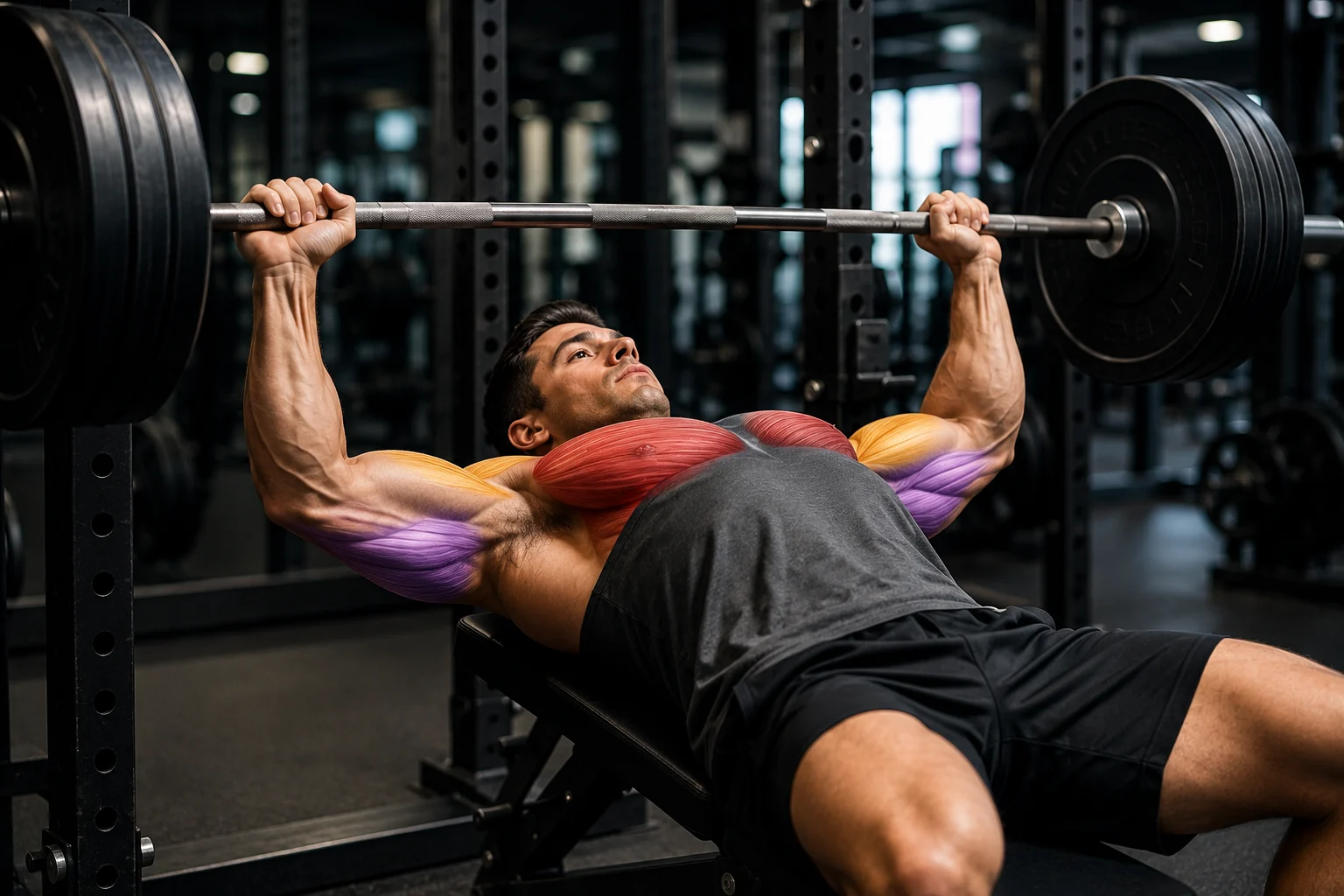
The bench press primarily works three major muscle groups: the pectoralis major (chest), triceps brachii (back of the upper arm), and anterior deltoids (front shoulders). Several other muscles, including the upper back, rotator cuff, serratus anterior and core, help stabilize your body and keep the movement controlled.
It is one of the most useful compound pressing exercises because several joints and muscle groups work together to move the bar. Research also supports its ability to develop the muscles involved. A study published in the Journal of Bodywork & Movement Therapies found measurable increases in muscle size after 10 weeks of bench press training, including the pectoralis major, pectoralis minor, anterior deltoid and triceps brachii.
The exact emphasis changes with your technique, grip width, bench angle and training goal. A powerlifter performing a competition-style bench press is using the same basic movement as someone training for chest development, but the way the lift is performed and evaluated can be quite different.
Which Muscles Does the Bench Press Work?
The main muscles involved in a standard flat barbell bench press are:
| Muscle | Main role during the bench press |
| Pectoralis major | Produces much of the pressing force |
| Triceps brachii | Extends the elbow and helps finish the press |
| Anterior deltoid | Assists the shoulder during the pressing movement |
| Pectoralis minor | Helps with shoulder-blade control |
| Serratus anterior | Supports scapular movement and stability |
| Rotator cuff | Helps stabilize the shoulder joint |
| Upper back muscles | Provide a stable base for the press |
| Core and lower body | Help maintain whole-body stability |
The first three are the muscles you should think of as the primary movers. The others play supporting or stabilizing roles.
That distinction matters. A muscle can be active during an exercise without being one of the main muscles responsible for moving the weight.
1. Pectoralis Major: The Main Chest Muscle
The pectoralis major is the large muscle covering most of the front of your chest, and it is the main muscle people usually associate with the bench press.
During the press, the pectoralis major helps bring the upper arm across the body while producing force against the bar. This is why the bench press is such a common exercise in chest-focused strength and hypertrophy training.
Research from the American Council on Exercise found that the barbell bench press produced the highest pectoralis major activation among the nine chest exercises tested in its study. The comparison included exercises such as push-ups, dips, chest press machines, dumbbell flyes and the pec deck.
That does not mean bench press is automatically the best exercise for every person or every training goal. Exercise selection depends on the individual, but it does show why the barbell bench press has remained a staple for developing pressing strength and chest musculature.
Does Bench Press Work the Entire Chest?
The pectoralis major is not one uniform section. It has different regions that can contribute differently depending on the position of the upper arm and the angle of the bench.
A flat bench press places substantial demand on the middle and lower portions of the pectoralis major. Raising the bench changes the movement and can increase the contribution from the upper, or clavicular, portion.
A 2020 study published in the International Journal of Environmental Research and Public Health examined bench press performance at five different angles. The researchers found that the upper portion of the pectoralis major showed its highest EMG activity at 30 degrees, while the middle and lower portions showed higher activity at a horizontal bench position.
This is one reason lifters often use both flat and incline pressing in a chest-focused training program.
2. Triceps Brachii: The Muscle Behind the Lockout
Your triceps brachii are located on the back of your upper arm and are responsible for extending the elbow.
Every time you press the bar upward, your elbow moves from a bent position toward extension. The triceps contribute to that action throughout the lift.
Their contribution becomes particularly noticeable toward the end of the press.
If the bar moves well from your chest but slows considerably before reaching full elbow extension, triceps strength may be one factor worth examining. That does not mean the triceps are always the limiting muscle. Bar path, technique, fatigue, chest strength and individual limb proportions can all influence where a lift becomes difficult.
The triceps also explain why the bench press should not be viewed as a chest-only exercise. It is a compound movement in which the chest, shoulders and arms have to coordinate to produce a successful repetition.
3. Anterior Deltoids: Your Front Shoulders
The anterior deltoid, often called the front delt, assists with shoulder movement during the bench press.
It works alongside the pectoralis major as you press the bar away from your chest. Its contribution can change significantly depending on the angle of the bench.
The research on bench angle is particularly useful here. One study found that anterior deltoid activity increased as the bench angle increased, while the contribution from parts of the pectoralis major changed in the opposite direction at steeper angles.
This is why an incline press can feel considerably different from a flat bench press. You have changed the position of the upper arm and torso, so the muscles do not share the workload in exactly the same way.
A steep incline can start to resemble a shoulder press more than a traditional chest press. If the goal is to emphasize the chest, moderate incline angles generally make more sense than simply raising the bench as high as possible.
Other Muscles Used During the Bench Press
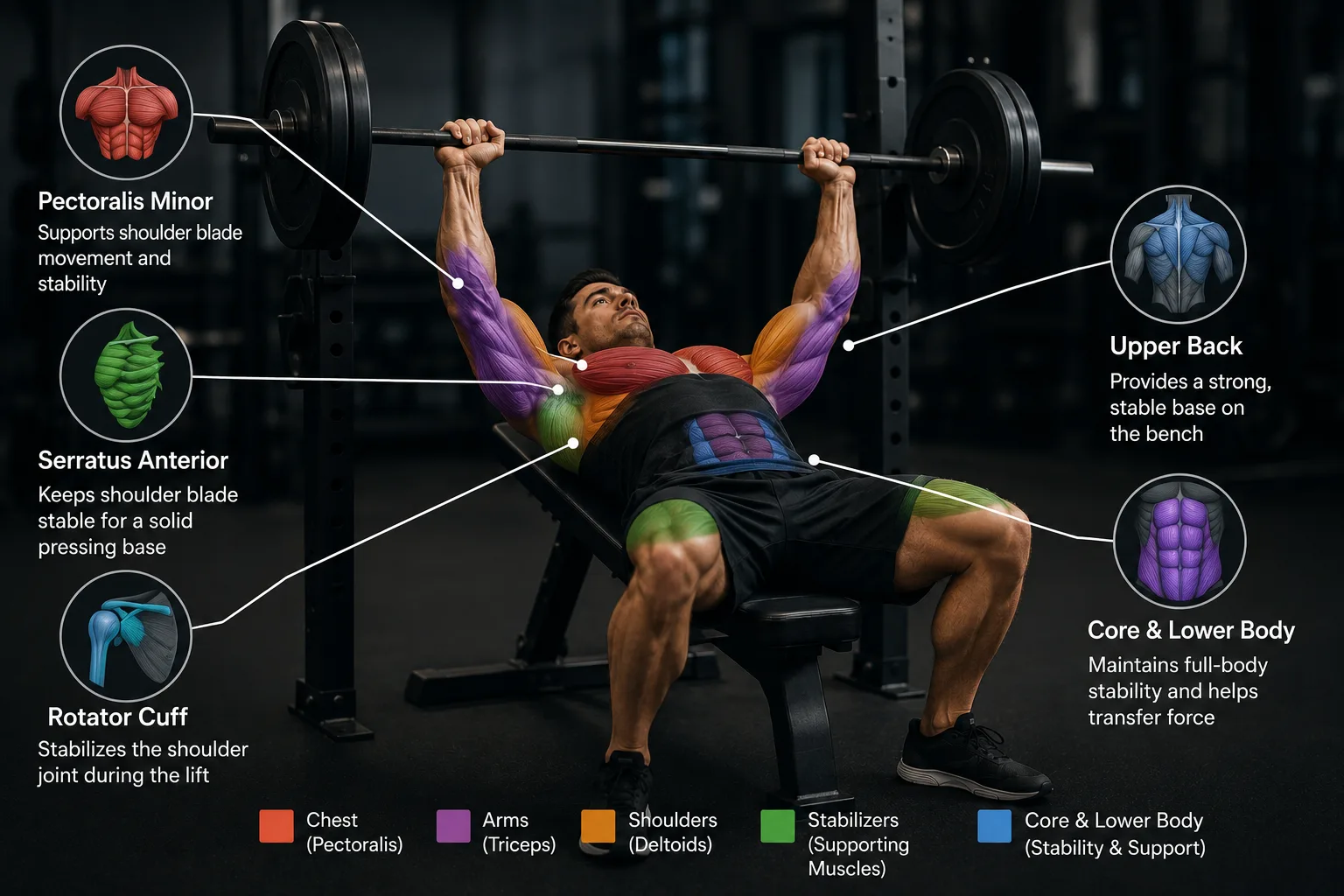
The chest, triceps and front delts get most of the attention, but they are not working in isolation.
Pectoralis Minor
The pectoralis minor sits underneath the pectoralis major and contributes to movement and positioning of the shoulder blade.
It is not a prime mover of the bench press in the same way as the pectoralis major. Its role is more closely related to controlling the shoulder complex.
Serratus Anterior
The serratus anterior is located along the side of the rib cage and plays an important role in scapular control.
A stable shoulder blade gives you a better base from which to press. This is one reason proper upper-body positioning matters even though you are primarily trying to move the bar with your chest, shoulders and arms.
Rotator Cuff
The rotator cuff is a group of four muscles that help stabilize the shoulder joint.
You are not bench pressing specifically to train the rotator cuff. Its job during the movement is primarily stabilization, helping the shoulder remain controlled while the larger muscles generate force.
Upper Back
Your upper back muscles are also important even though they do not push the bar upward.
A strong and stable upper back helps you maintain your position on the bench. During a controlled bench press, the shoulder blades remain organized against the bench while the upper back provides a firm base.
This becomes particularly important for lifters who train the bench press as a strength movement rather than simply performing repetitions for chest fatigue.
Core and Lower Body
The bench press is primarily an upper-body exercise, but your lower body still has a job.
Your feet provide contact with the floor, while your legs and trunk help you maintain a stable position. Good bench pressing is not about moving only your arms. The entire body contributes to creating a repeatable setup.
That does not mean bench press is a major leg or abdominal-building exercise. The lower body is mainly helping you stay stable and transfer force efficiently.
How the Muscles Work During Each Part of the Bench Press
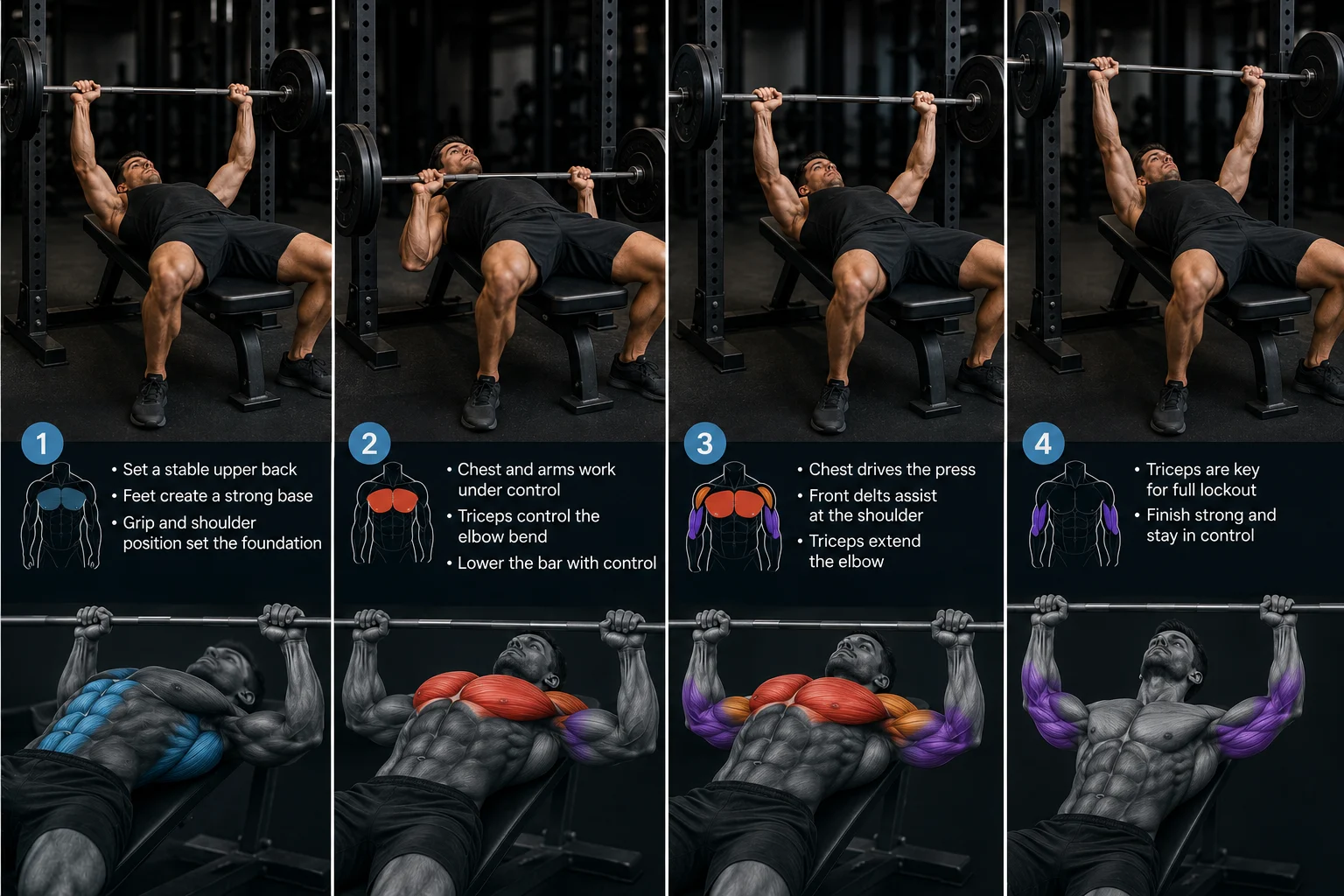
Understanding the movement makes the muscle roles easier to understand.
1. Setting Up
Before the bar moves, you establish your position on the bench.
Your upper back should be stable, your feet should provide a solid base and your grip should allow you to control the bar. Shoulder positioning is especially important because the shoulder joint has to remain stable while the arms move under load.
2. Lowering the Bar
As you lower the bar, the chest and other pressing muscles work under an eccentric load.
The triceps control elbow movement while the chest and shoulders help control the descent. You should not simply allow gravity to drop the bar toward your chest.
A controlled descent gives you a more consistent starting position for the press.
3. Pressing the Bar
This is where the main pressing muscles produce force.
The pectoralis major contributes strongly to moving the upper arm, the anterior deltoids assist at the shoulder and the triceps extend the elbow.
The muscles have to work together. A strong chest cannot compensate indefinitely for poor elbow control or an unstable shoulder position.
4. Locking Out
As your arms approach full extension, the triceps become especially important for finishing the movement.
For general gym training, people often stop thinking about the movement once the bar is moving upward. In strength competition, the final position matters.
GymLeague describes its bench press standard as a barbell bench press performed with full lockout, placing the exercise within a standardized strength-performance context.
Does Grip Width Change the Muscles Worked?
Yes. Grip width changes the mechanics of the bench press, which can alter how the workload is distributed between the chest, shoulders and triceps.
Wider Grip
A wider grip generally reduces the distance the bar has to travel and changes the position of your upper arms relative to your torso.
It can increase the contribution of the chest in some lifters while reducing the amount of elbow extension required compared with a much narrower grip.
That does not mean a wide grip isolates the chest. The triceps and shoulders still have important roles.
Narrower Grip
A narrower grip generally increases the amount of elbow extension required during the press.
That can make the triceps more noticeable, particularly during the latter portion of the lift.
Close-grip bench pressing is often used as an assistance exercise when a lifter wants additional triceps-focused pressing work.
Choose a Grip for More Than Muscle Sensation
The grip that feels the most chest tension is not automatically the best grip for improving your bench press.
Your training goal, shoulder comfort, body proportions, technique and competition requirements all matter.
For a strength athlete, the best grip is usually one that allows a strong, repeatable pressing position while meeting the required lifting standards.
Does Bench Angle Change Which Muscles Work?
Yes. Bench angle is one of the easiest ways to change the emphasis of the press.
Flat Bench Press
A flat bench is the traditional barbell bench press position.
It gives the pectoralis major a large role while also requiring substantial work from the triceps and anterior deltoids.
For strength athletes, the flat bench is also the version most closely associated with the competition bench press.
Incline Bench Press
As the bench becomes inclined, the upper portion of the pectoralis major and the anterior deltoids can contribute more.
Research has repeatedly shown that changing bench angle affects muscle activation. One study found that a 30-degree incline increased activation of the upper pectoralis major, while angles above 45 degrees produced substantially greater anterior deltoid activity and reduced pectoralis major performance.
This is a good example of why “more incline” does not automatically mean “more upper chest.”
Decline Bench Press
A decline position changes the shoulder angle and shifts the mechanics again.
It can place greater emphasis on the lower or sternocostal portion of the pectoralis major compared with steeper incline positions.
You do not need every possible bench angle in your program. Pick variations that serve a specific purpose.
Bench Press vs Other Chest Exercises
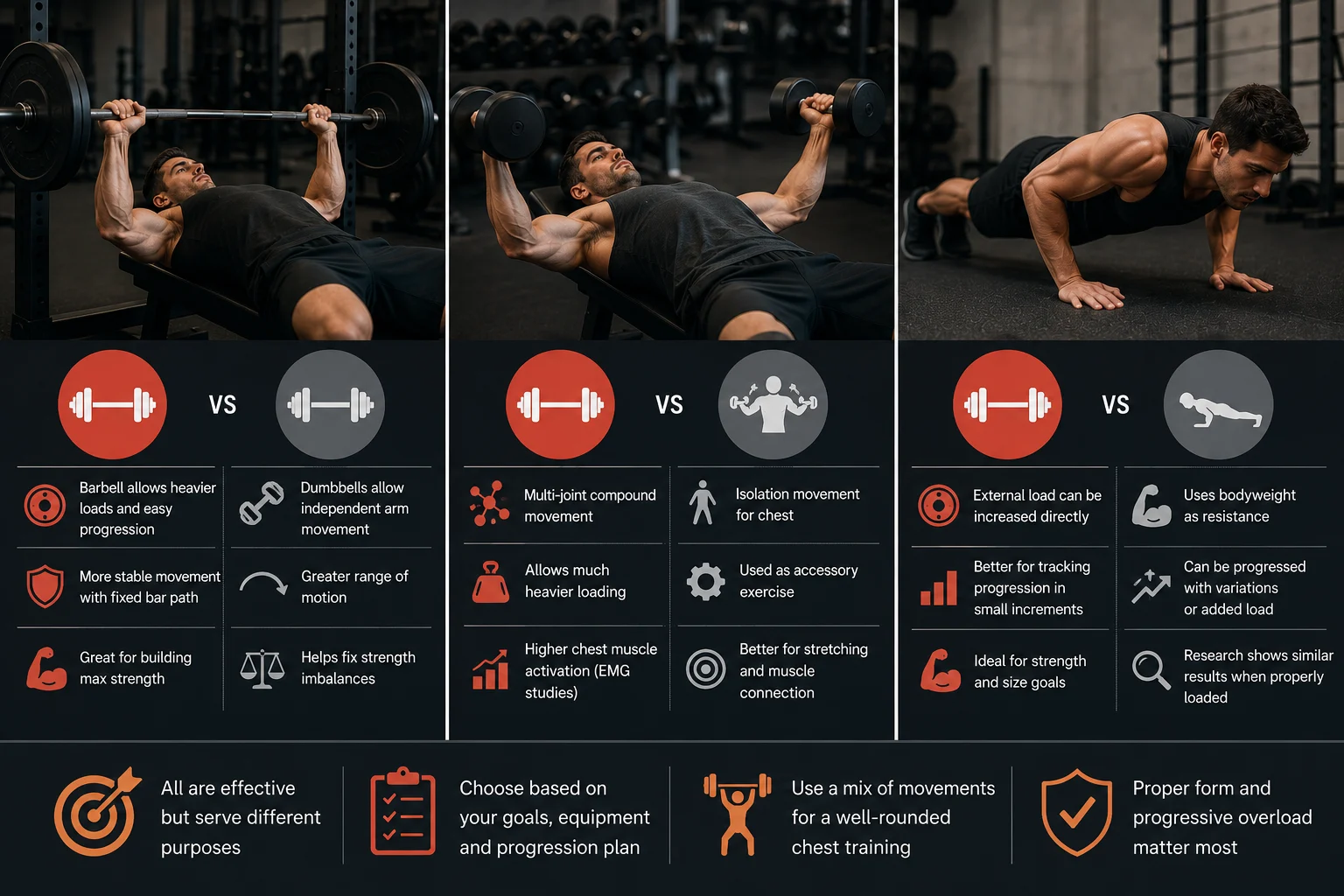
The bench press is different from exercises such as flyes, push-ups and machine presses because the loading and stability requirements are different.
Bench Press vs Dumbbell Press
Dumbbells allow each arm to move more independently and can provide a different range of motion.
A barbell, on the other hand, allows both hands to work with the same implement and makes it easier to progressively load the exercise in small increments.
Neither is universally superior. They are simply different tools.
Bench Press vs Chest Fly
A fly places the arms through a different movement pattern and is generally used as a chest-focused accessory exercise.
The bench press involves several joints and allows substantially heavier external loading.
The American Council on Exercise’s research found barbell bench press produced higher pectoralis major activation than the dumbbell fly variation included in its comparison.
That comparison should be interpreted in context. EMG activation is useful information, but it does not by itself determine which exercise will produce the most muscle growth for every person.
Bench Press vs Push-Ups
Push-ups and bench presses share a similar upper-body pressing pattern, but the loading method is different.
A bench press allows you to select an external load directly. Push-ups use your body mass as resistance and can be made harder through variations or additional load.
Research has also found that appropriately loaded push-ups can produce similar strength and hypertrophy outcomes to low-load bench pressing over a training period.
The useful question is not which exercise is universally better. It is which exercise fits your available equipment, training goal and progression strategy.
How to Get More From Your Bench Press
You do not need to make the exercise complicated to train the muscles effectively.
Keep Your Setup Consistent
Use a repeatable position for your feet, upper back, grip and shoulder blades.
Consistency makes it easier to identify whether you are actually getting stronger rather than simply changing technique from one session to the next.
Control the Descent
A controlled eccentric phase gives you better command of the bar and makes the starting point of the press more predictable.
You do not need to lower the bar extremely slowly. You need to control it.
Use a Repeatable Bar Path
The bar should not move randomly from repetition to repetition.
Small changes are normal, but a consistent path usually makes it easier to develop efficient technique.
Train the Muscles That Limit You
If your chest is the weak point, additional chest pressing may be useful.
If you consistently struggle near lockout, triceps-focused work may have a place in your program.
If your position breaks down before the bar reaches your chest, improving setup and upper-back stability may matter more than adding another isolation exercise.
The answer should come from your actual lifting performance rather than simply choosing an exercise because a particular muscle feels sore afterward.
Common Bench Press Mistakes
Using More Weight Than You Can Control
Adding weight too quickly can change your technique and make every repetition look different.
A lighter load that you can control is often more useful for building a reliable movement pattern.
Losing Your Upper-Back Position
If your shoulder position changes dramatically during the set, the movement becomes less consistent.
Set your upper back before unracking the bar and maintain that position throughout the repetition.
Bouncing the Bar
Allowing the bar to crash onto the chest reduces control and changes the movement.
A controlled touch followed by a deliberate press is a better standard for normal training.
Cutting the Range of Motion Short
Partial repetitions can have a place in specific training programs, but they should not accidentally replace full-range repetitions.
If you are training for a standardized strength lift, range of motion and completion requirements matter even more.
Ignoring the Lockout
A repetition is not finished simply because the bar has passed the most difficult point.
For competitive strength lifting, the final position is part of the lift. The big-three structure places the bench press alongside the squat and deadlift as its core lifts, with the bench press defined around a full lockout.
What Does Bench Press Work the Most?
If you want the short answer, the bench press primarily trains:
- Pectoralis major
- Triceps brachii
- Anterior deltoids
It also requires assistance from the pectoralis minor, serratus anterior, rotator cuff, upper-back muscles and the muscles that keep your trunk and lower body stable.
The amount of work each muscle performs depends on the way you bench.
A flat press generally gives the chest a major role. A moderate incline can shift more emphasis toward the upper portion of the chest, while steeper angles increase the contribution from the front deltoids. Grip width also changes the mechanics and can alter the relative demands on the chest and triceps.
How Bench Press Fits Into Powerlifting
The bench press has a special place in strength training because it is one of the three classic powerlifting lifts, alongside the squat and deadlift.
Our Big Three section identifies the squat, bench press and deadlift as its core lifts. The platform describes the bench press as an upper-body test of pressing power and emphasizes full lockout as part of its bench press standard.
This creates an important distinction between training for muscle development and training for a judged strength lift.
A person training primarily for chest growth may select an exercise based on comfort, muscle stimulus and fatigue management.
A lifter training for a competition needs to think about the complete movement. The weight has to be controlled, the technique has to meet the applicable standard and the repetition has to count according to the rules.
Our approach is built around verified performance, defined standards and transparent judging rather than simply recording the biggest number someone claims to have lifted.
How to Build a Stronger Bench Press
Building a stronger bench press takes more than repeatedly attempting heavier weights.
Practice the Competition Movement
If strength performance is your goal, spend enough time practicing the exact movement you want to improve.
Build Your Pressing Muscles
The chest, triceps and shoulders all contribute to the lift, so your supporting work should reflect your individual weaknesses.
Improve Technique Before Chasing Weight
A technically consistent 100 kg bench is more useful than a technically inconsistent 105 kg attempt if the heavier lift cannot be repeated under the same standards.
Use Assistance Exercises With a Reason
Dumbbell presses, incline presses, close-grip bench presses, rows and triceps exercises can all have a place in a strength program.
The key is knowing why you are using them.
Track Your Progress
Record your working weights, repetitions and technique.
If your bench has stalled, look at the entire lift rather than assuming one muscle is automatically responsible.
The Bottom Line
The bench press is primarily a chest, triceps and front-shoulder exercise, but it is much more than a chest movement.
The pectoralis major provides a large share of the pressing force. The triceps extend the elbow and help finish the lift, while the anterior deltoids assist at the shoulder. Your upper back, rotator cuff, serratus anterior, core and lower body help you maintain a stable position throughout the movement.
Grip width, bench angle and technique can change how the workload is distributed. That is why the same bench press can be used for different purposes, from building muscle to developing maximum pressing strength.
For lifters who care about measurable strength and standardized performance, the details matter even more. GymLeague brings the bench press into that setting by treating it as one of the Big Three lifts and emphasizing verified performance, clear standards and fair competition.