
The average male bench press is around 96 kg (212 lb) for a one-rep max, according to current data from Strength Level. Another large training-log dataset from StrengthLog puts the average at 100 kg (220 lb). Those figures are useful benchmarks, but they should not be interpreted as the amount every adult man can bench. Both datasets are built around people who record strength-training lifts, so they are much closer to the average male lifter than the average man in the general population.at
That distinction matters. A 100 kg bench press means something very different for a 60 kg lifter than it does for someone weighing 100 kg. Training experience, age, bodyweight, technique and lifting standards all affect how a bench press number should be judged.
So, if you’re asking how much does the average man bench press, the short answer is roughly 96 to 100 kg for a one-rep max among the lifters represented in these databases. The more useful question is where your own bench sits compared with people of a similar bodyweight and training level.
What Is the Average Bench Press for a Man?

There is no single number that can represent every man who has ever touched a barbell.
Strength Level currently reports an average male bench press of 96 kg (212 lb) for one repetition. Its dataset contains more than 48 million recorded lifts collected between 2014 and 2026. Its overall male standards place 96 kg at the intermediate level.
StrengthLog reports a slightly higher figure of 100 kg (220 lb) for men, based on training logs from its users. Its data also places 100 kg at the intermediate level.
The difference does not mean one source is right and the other is wrong. They are using different databases, users and methods of collecting training information.
It also explains why you should be cautious with statements such as “the average man can bench 100 kg.” A man who has never followed a strength-training programme is not represented in the same way as someone who regularly logs bench presses.
Average Man vs Average Male Lifter
This is probably the most important distinction in the entire topic.
Imagine two groups:
- Group one contains every adult man, including people who never strength train.
- Group two contains people who regularly perform and record bench presses.
The second group’s average will naturally be much higher.
Most online strength standards are based on the second type of group. They are useful for lifters because they allow you to compare your performance with other people who actually train, but they should not be presented as a measurement of the general male population.
That’s why a reported average of around 96 to 100 kg should be treated as a strength-training benchmark, not a biological average for all men.
How Much Should a Man Bench Press Based on Experience?
Training experience changes the picture considerably.
Strength Level’s current male standards give the following approximate one-rep-max benchmarks:
| Level | Bench press |
| Beginner | 49 kg / 107 lb |
| Novice | 70 kg / 154 lb |
| Intermediate | 96 kg / 212 lb |
| Advanced | 127 kg / 280 lb |
| Elite | 160 kg / 353 lb |
These figures are based on Strength Level’s recorded lifts rather than a formal laboratory study. They are best used as comparison points rather than strict requirements.
Beginner Bench Press
A beginner is still developing the basic skill of bench pressing.
The first few months are about more than adding plates. The lifter is learning how to position the shoulders, control the bar, maintain a stable upper back and press through a consistent range of motion.
Strength Level puts the beginner male benchmark at about 49 kg (107 lb) for a one-rep max.
That does not mean a new lifter should immediately test a true one-rep maximum. A beginner can make excellent progress using manageable weights and gradually increasing the load as technique improves.
Novice Bench Press
The novice stage generally represents someone who has moved beyond the earliest phase of training and has developed some consistency.
Strength Level’s benchmark is around 70 kg (154 lb).
At this point, the lifter usually has a better understanding of setup and bar control. Progress may still come relatively quickly, but improvements are less about simply learning the movement and more about building actual strength.
Intermediate Bench Press
The intermediate benchmark is around 96 kg (212 lb) according to Strength Level.
This is interesting because it sits almost exactly alongside the site’s reported average male bench press.
It does not mean the average man is automatically an intermediate lifter. It means the database’s overall male average happens to fall around the intermediate benchmark.
That is an important difference.
Advanced Bench Press
An advanced benchmark is around 127 kg (280 lb).
At this level, the lifter is considerably stronger than the typical recreational lifter. Improvements tend to become harder to earn, and small technical changes, programming decisions, recovery and body weight can have a noticeable effect on performance.
Elite Bench Press
Strength Level places the elite male benchmark around 160 kg (353 lb).
That is a serious bench press by almost any recreational standard.
Elite numbers should not be used as normal targets for someone who simply wants to become stronger. Competitive strength athletes spend years developing the technical skill and physical qualities required to reach this level.
Average Bench Press by Bodyweight

Bodyweight is one of the biggest reasons a single average can be misleading.
Strength Level’s current data shows how the expected bench press changes as bodyweight changes. For example, its intermediate male standards are approximately 72 kg at 60 kg bodyweight, 98 kg at 80 kg bodyweight, 109 kg at 90 kg bodyweight and 120 kg at 100 kg bodyweight.
That gives you a much better way to judge a lift.
A 60 kg Man
A 60 kg lifter with a 70 kg bench press is pressing more than bodyweight.
According to Strength Level, around 72 kg represents its intermediate benchmark at this bodyweight.
So a 70 kg bench is a meaningful lift for a 60 kg lifter, even though it is far below the overall 96 kg male average.
An 80 kg Man
For an 80 kg lifter, Strength Level’s intermediate benchmark is around 98 kg.
A 100 kg bench would therefore be roughly 1.25 times bodyweight.
This is one reason bodyweight ratios are useful. They give you a better idea of how much strength a lifter has relative to their size.
A 90 kg Man
At 90 kg bodyweight, the intermediate benchmark rises to approximately 109 kg.
A 100 kg bench is still a solid lift, but it represents a smaller bodyweight multiple than it does for an 80 kg lifter.
A 100 kg Man
For a 100 kg lifter, Strength Level puts the intermediate benchmark around 120 kg.
A 100 kg bench is still a respectable milestone, but it is no longer a bodyweight bench.
This is why asking whether a number is “good” without knowing the lifter’s bodyweight can lead to poor comparisons.
How Much Should You Bench for Your Bodyweight?
One of the easiest benchmarks to understand is the relationship between your bench press and your bodyweight.
Strength Level currently gives these broad male bodyweight ratios:
- Beginner: around 0.50 × bodyweight
- Novice: around 1.00 × bodyweight
- Intermediate: around 1.25 × bodyweight
- Advanced: around 1.50 × bodyweight
- Elite: around 2.00 × bodyweight
These are useful reference points, not rules.
Is a 1× Bodyweight Bench Press Strong?
For a recreational lifter, benching your own bodyweight is a meaningful milestone.
It is also a simple target because it is easy to understand. If you weigh 80 kg and bench 80 kg, you have pressed your body weight.
That does not automatically make you an advanced lifter. Strength Level’s current standards place a 1× bodyweight bench around its novice benchmark for the overall male population.
Still, it is a solid achievement for someone who has trained consistently.
Is a 1.25× Bodyweight Bench Press Strong?
A bench press around 1.25 times bodyweight is closer to the intermediate benchmark in Strength Level’s current standards.
For an 80 kg lifter, that would be about 100 kg.
For a 100 kg lifter, it would be about 125 kg.
The same ratio can therefore represent very different absolute weights.
What About 1.5× Bodyweight?
A 1.5× bodyweight bench is a much more demanding target.
An 80 kg lifter would need to bench around 120 kg.
A 100 kg lifter would need around 150 kg.
Strength Level places the 1.5× ratio around its advanced benchmark. Reaching it requires considerably more strength and usually several years of serious, consistent training.
What About a 2× Bodyweight Bench?
A double-bodyweight bench is an entirely different level.
For an 80 kg lifter, that means 160 kg.
For a 100 kg lifter, it means 200 kg.
Strength Level places a 2× bodyweight bench around its elite benchmark. It is not a normal recreational target, and very few lifters will reach it.
Average Bench Press by Age
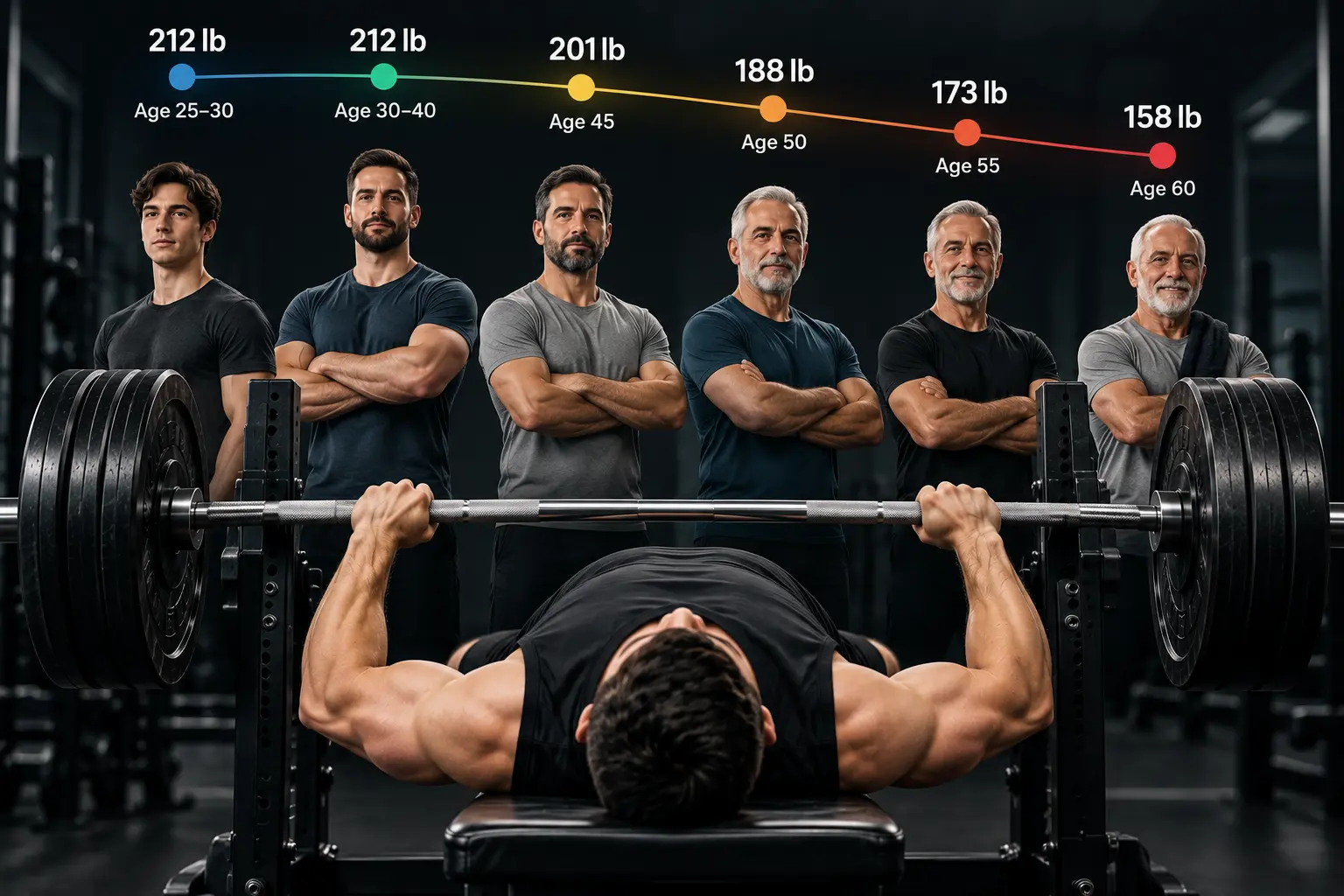
Age also changes strength expectations, although it should not be viewed in isolation.
Strength Level’s current male data shows its intermediate benchmark at around 212 lb for ages 25 through 40, then gradually lower benchmarks in the older age groups. For example, its intermediate figures are approximately 201 lb at 45, 188 lb at 50, 173 lb at 55 and 158 lb at 60.
These figures show a general pattern in the database, but they should not be treated as a prediction of what an individual can lift.
Bench Press in Your 20s and 30s
For younger adults, training experience often explains more of the difference than age.
A 35-year-old who has trained consistently for eight years can be considerably stronger than a 25-year-old who started lifting six months ago.
There is no reason to assume that reaching your 30s means your strength has to decline.
Bench Press in Your 40s and 50s
Lifters in their 40s and 50s can still develop substantial pressing strength.
Training history becomes especially useful here. Someone who has spent years developing muscle and technique starts from a very different position than someone beginning resistance training later in life.
Recovery also becomes more important. Training volume, exercise selection, sleep and managing accumulated fatigue can affect progress.
Bench Press After 60
Strength can still be trained at older ages.
Absolute numbers generally decline in age-based datasets, but that does not make strength training less worthwhile. A 65-year-old who maintains a strong, controlled bench relative to their bodyweight and training history may be performing extremely well.
Age should provide context, not become an excuse to stop progressing.
Is a 100 kg Bench Press Good?
Yes. A 100 kg bench press is a strong milestone for many recreational lifters.
The context matters.
For an 80 kg lifter, 100 kg is 1.25 times bodyweight and sits close to Strength Level’s intermediate benchmark.
For a 100 kg lifter, it is a bodyweight bench.
For a 60 kg lifter, it is substantially more than bodyweight and represents a much larger relative strength achievement.
StrengthLog’s current database places 100 kg at its intermediate male benchmark, based on training logs from its users.
So yes, 100 kg is a good number. It just does not tell the whole story by itself.
Is a 140 kg Bench Press Good?
A 140 kg (309 lb) bench press is well beyond what most recreational lifters will achieve.
For an 80 kg lifter, it is 1.75 times bodyweight.
For a 100 kg lifter, it is 1.4 times bodyweight.
Strength Level’s overall male advanced benchmark is around 127 kg, while its elite benchmark is around 160 kg. A 140 kg bench therefore sits in serious strength territory, although the exact classification depends on bodyweight and the standard used.
The number should be even more impressive if it is performed under strict competition conditions with the required range of motion, pause and lockout.
What Counts as a Proper Bench Press?
The number on the bar only tells part of the story.
If two people claim a 100 kg bench press but perform the lifts differently, comparing them directly may not make much sense.
For a standardized strength lift, the repetition needs clear rules.
ExRx’s bench press standards, for example, specify that the bar should contact the chest above the bottom of the sternum, include a momentary pause, and finish with full elbow extension.
That is considerably different from simply lowering the bar partway and pressing it back up.
Range of Motion
The bar should travel through a consistent range of motion.
Cutting the descent short can make a heavy weight easier to move, but it also makes the lift difficult to compare with a properly performed repetition.
Lockout
The press is not complete simply because the bar has passed the sticking point.
Full elbow extension provides a clear finishing position.
This becomes especially important when a lift is being judged or verified.
Technique and Competition Standards
There is a difference between:
- A heavy bench performed during an ordinary gym session
- A personal record tested in training
- A one-rep-max attempt
- A competition-standard bench press
All four can involve the same bar and plates, but they do not necessarily use the same standards.
That distinction is important when comparing numbers online.
Why Your Bench Press May Be Above or Below Average
There are several perfectly normal reasons your number might not match the average.
Bodyweight and Muscle Mass
A larger body does not automatically mean a stronger bench press, but bodyweight does influence absolute strength.
A 70 kg lifter and a 110 kg lifter should not be judged solely by the weight on the bar.
Training Experience
Someone who has trained the bench press consistently for five years has had thousands of opportunities to improve technique, build muscle and develop pressing strength.
Someone who started three months ago has not.
That sounds obvious, but online comparisons often ignore it.
Technique and Body Proportions
Arm length, torso dimensions, grip width and setup can all affect the mechanics of the bench press.
Two lifters with the same bodyweight can have very different natural advantages and disadvantages.
The same weight may travel a shorter distance for one lifter than another.
Strength Training vs Muscle Building
A person training primarily for muscle growth may perform most of their bench work in moderate rep ranges.
A powerlifter preparing for a competition will spend more time practicing heavy, competition-specific pressing.
Both lifters may be strong. They are simply training for different outcomes.
For more detail on the muscles involved in the movement, see this guide to the muscles used during the bench press.
Common Mistakes When Comparing Bench Press Numbers
Comparing a 1RM With a Rep Set
A person who benches 100 kg for five repetitions is not in the same situation as someone who can only lift 100 kg once.
A five-rep set can be used to estimate a one-rep max, but the two numbers should not be treated as identical.
Ignoring Bodyweight
Saying “I bench 100 kg” without mentioning bodyweight removes an important part of the comparison.
The same 100 kg lift can represent very different levels of relative strength.
Comparing Gym Lifts With Competition Lifts
A gym lift might have a different setup, range of motion, pause and lockout standard.
A competition lift has to satisfy the rules being used.
Believing Social Media Represents the Average
Social media has a selection problem.
People are more likely to post a 200 kg bench than a 60 kg bench. Strong lifters also tend to attract more attention.
That can make very high numbers appear much more common than they actually are.
Testing Your 1RM Too Often
A one-rep maximum is useful for measuring strength, but constantly testing it is not the same as training effectively.
Most strength gains are built through repeated quality work, not weekly attempts to prove that you are stronger.
Treating One Bad Session as a Loss of Strength
Sleep, food, stress, fatigue and previous training can all affect performance.
Missing a weight on one day does not necessarily mean you have become weaker.
Look at the trend over several weeks.
How to Improve Your Bench Press
If your current bench is below the benchmark you want, the answer is usually not complicated.
Bench Consistently
The bench press is a skill as well as a strength exercise.
Regular practice helps you develop a repeatable setup, bar path and pressing technique.
Improve Your Setup
A stable upper back, firm foot position and consistent grip can make the movement more efficient.
You should be able to reproduce your setup from one session to the next.
Build the Muscles Behind the Lift
The chest, triceps and front shoulders all contribute to pressing strength.
Your upper back also matters because it provides a stable base for the movement.
If your progress has stalled, look at which part of the lift is actually limiting you before adding random exercises.
Work on Your Weak Point
If the bar consistently stalls close to your chest, the issue may be different from a lifter who has no problem getting the bar moving but struggles to finish the repetition.
Those two lifters may benefit from different training approaches.
Track Your Lifts
Record your:
- Weight
- Repetitions
- Bodyweight
- Training date
- Estimated one-rep max
- Technique notes
This gives you something much more useful than memory.
A 2.5 kg improvement may look small on paper, but over several months it can represent meaningful progress.
How Does Your Bench Press Compare?
If you want to know whether your bench is average, above average or genuinely strong, use more than one number.
Start with your bodyweight.
Then establish your best recent one-rep max or a sensible estimate from a controlled set. Compare that number with a bodyweight-specific standard rather than relying only on the overall male average.
After that, consider your training age and age group.
Finally, make sure you are comparing lifts performed to similar standards.
A 90 kg bench at 70 kg bodyweight tells a different story from a 90 kg bench at 100 kg bodyweight. A paused, full-range competition lift also tells a different story from a partial repetition performed for a social-media video.
What the Average Bench Press Really Tells You
So, how much does the average man bench press?
For the lifting populations represented by current strength databases, the answer is roughly 96 to 100 kg (212 to 220 lb) for a one-rep max. Strength Level reports 96 kg, while StrengthLog reports 100 kg.
But the number needs context.
It does not mean that every adult man should be able to bench 100 kg. It does not mean that someone benching 80 kg is weak. It does not mean that a 140 kg bench is automatically elite.
Bodyweight, age, training experience and execution standards all change the picture.
A better way to judge your bench press is to compare your performance with lifters of a similar bodyweight and experience level, then track whether your own strength is moving in the right direction.
For a lifter, that is usually more useful than chasing a single number labelled “average.”
Verified Strength Matters
For competitive lifters, the number only has real meaning when people can agree on what counts as a successful lift. That is where defined standards and independent verification become useful.
GymLeague is built around verified strength performances, allowing lifters to submit squat, bench press and deadlift videos for verification. The focus is on making strength results easier to compare when the lift is performed against clear standards.
If you are tracking your own progress, the most useful benchmark is not simply whether you have reached the average. It is whether your lifts are being performed consistently, whether your numbers are improving, and whether the performance can stand up to a clear standard.